Homeowners across Sydney and the Central Coast often call Adam Pro after receiving three wildly different quotes for the same cement rendering job on a single-storey brick home.
In 2026, cement rendering in NSW and the ACT typically costs $65 to $95 per square metre including labour and materials, with most Sydney homes falling between $12,000 and $28,000 depending on size, access and finish.
Adam Pro has tracked these prices across 15 years of projects in Sydney, Newcastle, Wollongong and Canberra, giving homeowners clear benchmarks they can use when comparing quotes.
What You Will Learn in This 2026 Cement Rendering Cost Guide
- Current 2026 price per square metre for cement rendering in NSW/ACT
- Real cost examples for different house sizes including two-storey homes
- Labour versus material cost breakdown
- How prices vary between Sydney, Central Coast, Newcastle and Canberra
- Acrylic versus cement rendering cost comparison
- What every quote should include and common hidden costs to watch for
Cement Rendering Price Per Square Metre in NSW and ACT 2026
The cement rendering price per square metre in NSW and the ACT in 2026 sits between $65 and $95 for standard residential work. That range covers labour and materials on a properly prepared surface. Projects requiring extensive surface repairs, difficult access or premium finishes push toward the higher end or beyond it.
Cement rendering prices in NSW are influenced by the Australian Bureau of Statistics construction cost index for 2026.
| Cost Tier | Price per m² | Labour Component | Material Component |
|---|---|---|---|
| Low | $65 | $36–$40 | $25–$29 |
| Mid | $80 | $44–$52 | $28–$36 |
| High | $95+ | $52–$62 | $33–$43 |
These figures reflect standard single-coat and double-coat cement render on brick or block substrates. Decorative finishes, texture coatings or premium smooth render add cost at each tier.
One pattern that surprises many homeowners: poor surface preparation on older brickwork can add 15 to 20% to the final bill. Fifteen years of residential and commercial projects across NSW confirm that cutting corners on prep consistently creates problems that cost more to fix than the original saving. Cracks, delamination and moisture ingress nearly always trace back to inadequate substrate preparation, not the render product itself.
The rendering costs shown above assume reasonable access. Narrow side passages, sloped blocks and sites with no vehicle access for material delivery all create additional charges that a per-m² rate alone does not capture.
Average Cost to Render a Home in Australia 2026
The average cost to render a home in Australia in 2026 ranges from $9,750 for a small single-storey home to $28,500 or more for a large two-storey property, based on the $65 to $95 per m² range applied to typical wall surface areas. Sydney metro averages sit 12 to 18% above the national median according to 2026 Master Builders Association data.
These worked examples show how totals are calculated for three common home sizes:
150 m² renderable wall area (small single-storey home)
- Low estimate: 150 × $65 = $9,750
- High estimate: 150 × $95 = $14,250
- Typical range: $9,750 to $14,250
250 m² renderable wall area (medium single-storey or small two-storey home)
- Low estimate: 250 × $65 = $16,250
- High estimate: 250 × $95 = $23,750
- Typical range: $16,250 to $23,750
300 m² renderable wall area (large home or two-storey)
- Low estimate: 300 × $65 = $19,500
- High estimate: 300 × $95 = $28,500
- Scaffolding premium for two-storey: add $2,500 to $5,000
- Typical range with scaffolding: $22,000 to $33,500
Two-storey homes often cost 25 to 35% more per m² than equivalent single-storey projects. Scaffolding hire, additional labour time and site safety requirements account for most of that difference.
Clients in the Hills District frequently underestimate scaffolding costs until the second storey gets quoted separately. A quote that looks competitive on paper can shift by $3,000 to $5,000 once scaffolding is added as a line item, which is exactly why your quote should always specify whether scaffolding is included before you sign anything.
Labour Versus Material Cost Split for Cement Rendering
Labour accounts for 55 to 65% of the total cost on residential rendering projects in NSW. That split matters when you compare quotes, because two quotes at the same total price can reflect very different levels of workmanship and material quality.
Material prices for cement render have risen 7% year-on-year in NSW per 2026 ABS data.
| Cost Component | Percentage of Total | Dollar Range (per m² at $80 mid) |
|---|---|---|
| Labour Costs | 55–65% | $44–$52 |
| Material Costs | 35–45% | $28–$36 |
| Total | 100% | $80 |
Material Costs include the render mix, bonding agents, mesh, primers and any finishing coats. Labour Costs cover surface preparation, application, detailing around windows, doors and corners, and site clean-up.
Experienced renderers know that rushed material delivery on tight project timelines often inflates labour hours. When materials arrive late or in incorrect quantities, tradespersons spend time managing logistics rather than applying render. That time ends up on your bill one way or another, either as a direct charge or absorbed into a contingency that was priced in from the start.
Asking a contractor to break down their quote into Labour Costs and Material Costs separately gives you a quick sense of whether their pricing reflects genuine work or padding.
Regional Price Variations Across NSW and ACT in 2026
Rendering prices vary between regions for several practical reasons: travel time, local trade availability, site compliance requirements and material freight costs. The table below shows 2026 price ranges across the main areas of NSW and the ACT.
Northern Beaches and Eastern Suburbs consistently sit at the higher end of Sydney rendering prices in 2026.
| Region | Price Range per m² | Notes |
|---|---|---|
| Sydney Inner Metro | $80–$95 | High demand, premium access areas |
| Northern Beaches / Eastern Suburbs | $85–$100 | Narrow access, premium suburb loading |
| Hills District / Western Suburbs | $70–$90 | Competitive market, good access |
| Central Coast | $70–$88 | Lower demand pressure than metro |
| Newcastle / Hunter Valley | $68–$85 | Strong trade base, competitive pricing |
| Wollongong / Illawarra | $68–$88 | Variable by suburb and access |
| Southern Highlands | $72–$90 | Some travel loading applies |
| Canberra / ACT | $78–$100 | Stricter site compliance, higher base |
Canberra projects often run 8 to 12% higher than Sydney metro due to stricter site compliance requirements under ACT building regulations.
Clients in regional areas like Nelson Bay are often surprised by travel charges that Sydney metro quotes omit. A contractor based in Sydney quoting a Nelson Bay job will factor in mobilisation costs, and those charges are legitimate, but they should appear as a clear line item rather than being hidden inside the per-m² rate.
Exterior rendering costs across all these regions also depend on the condition of existing render or substrate. A wall requiring crack repairs, old render removal or anti-fungal treatment before new render can be applied will attract additional charges regardless of location.
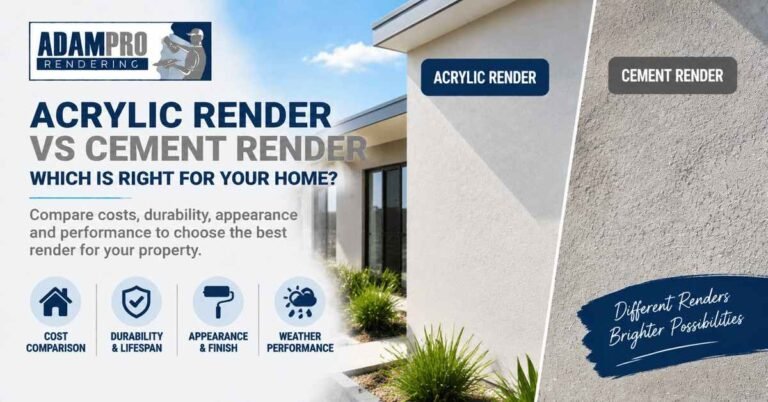
Acrylic Versus Cement Rendering Cost Comparison 2026
The cost of acrylic rendering versus cement rendering in 2026 shows a consistent pattern across NSW and the ACT. Acrylic systems carry a higher upfront price, while cement render offers a lower initial cost with potentially higher long-term maintenance in exposed conditions.
Cement render remains the most specified system for new residential builds in NSW under current BCA requirements.
| Feature | Cement Render | Acrylic Render |
|---|---|---|
| Cost per m² (2026) | $65–$95 | $80–$120 |
| Upfront cost premium | Baseline | 20–30% higher |
| Typical lifespan | 20–40 years (maintained) | 15–25 years |
| Maintenance frequency | Moderate (painting required) | Lower (pre-coloured) |
| Flexibility on movement | Lower | Higher |
| BCA residential specification | Common | Common |
| Best suited for | New builds, classic finishes | Renovations, flexible substrates |
Acrylic systems cost 20 to 30% more upfront but often reduce maintenance expense over a 10-year period because they arrive pre-coloured and resist moisture more naturally than painted cement render.
Many renovators still choose cement render despite that maintenance difference. The classic sand-and-cement finish has a weight and texture that acrylic products cannot replicate, and for heritage properties or homes where the owner wants a specific aesthetic, that matters more than the 10-year maintenance comparison.
Your choice between these two systems should factor in substrate type, location, budget and the look you want, not just the per-m² price difference alone.
Transparent Quote Inclusions and Exclusions Checklist
Under Australian Consumer Law 2026, all major rendering quotes must clearly state inclusions and exclusions. A quote that lists only a total price and a per-m² rate leaves too much room for disputes once work begins.
Homeowners regularly report being caught out by separate charges for scaffolding that were never raised during initial discussions. By the time scaffolding gets mentioned, the contract is often signed and the homeowner has no leverage to negotiate.
Every cement rendering quote should include:
- Total renderable wall area measured and specified in m²
- Number of render coats (single coat, double coat or scratch coat plus finish)
- Surface preparation scope, including patching, cleaning and bonding agents
- Scaffolding: whether included or excluded, and estimated cost if separate
- Site protection for windows, doors, paving and gardens
- Materials specified by product name or system type
- Site clean-up and waste removal
- Payment schedule tied to project milestones
- Warranty terms for both workmanship and materials
Common exclusions to watch for:
- Scaffolding and elevated work platform hire
- Removal of existing defective render
- Crack repairs beyond a stated depth or width
- Anti-fungal or mould treatment on affected walls
- Travel charges for regional or remote sites
- Painting or colour coating after render application
Ask every contractor to confirm these items in writing before accepting a quote. A transparent quote protects both you and the contractor, and it makes comparing three quotes for the same job far more reliable.
Why Homeowners and Builders Choose Adam Pro for Cement Rendering
Adam Pro has delivered residential and commercial rendering projects across NSW and the ACT for 15 years. That track record covers everything from single-storey brick homes in the Hills District to multi-storey commercial facades in Sydney’s Eastern Suburbs and regional properties along the NSW South Coast.
- 15 Years of Industry Experience across Sydney, Newcastle, Wollongong, Central Coast, Southern Highlands and Canberra
- Fully Licensed and Insured Professionals on every project
- Free Quotes and Site Inspections with no obligation
- Competitive Pricing with Clear Inclusions, including scaffolding, surface preparation and site protection specified upfront
- Large Service Coverage Across NSW and ACT, with dedicated teams for metro and regional projects
- Workmanship and Material Warranties Where Applicable
Call 0444 522 239 or email adam@adampro.com.au for a free site inspection and detailed quote.
Frequently Asked Questions
What is the average cost of cement rendering in 2026?
Pricing for cement rendering in NSW and the ACT in 2026 runs from $65 to $95 per square metre including labour and materials. A small single-storey home with 150 m² of wall area typically costs $9,750 to $14,250, while a larger two-storey property can reach $28,500 or more. These benchmarks come from 15 years of projects tracked by Adam Pro across NSW.
How much does it cost to render a house in Sydney?
To render a house in Sydney in 2026, budget between $12,000 and $28,000 for most standard homes. A 150 m² single-storey home sits at the lower end, while a 300 m² two-storey property with scaffolding reaches the upper range. Inner metro and Northern Beaches suburbs attract a 5 to 10% premium compared to Western Suburbs pricing due to access and demand.
What factors influence cement rendering costs?
Surface condition, wall area, access difficulty, finish type and location all affect cement rendering costs. Older walls needing crack repairs or old render removal add to the base rate. Two-storey homes require scaffolding, which adds $2,500 to $5,000. Premium finishes such as smooth render or decorative texture coating sit above standard sand-and-cement pricing.
How much does cement rendering cost for a 300 square metre house?
A 300 m² wall area costs $19,500 to $28,500 at the standard 2026 rate of $65 to $95 per m². For a two-storey home at that size, add $2,500 to $5,000 for scaffolding, bringing the total to $22,000 and $33,500. Surface condition and finish specification shift the final figure within or beyond that range.
When should you choose cement render over acrylic render?
Cement render suits new builds, heritage properties and projects where a classic sand-and-cement texture is preferred. It costs $65 to $95 per m² in 2026, compared to $80 to $120 for acrylic systems. Choose cement render when budget, BCA compliance for new construction, or aesthetic preference for a traditional finish outweighs the lower maintenance appeal of acrylic.
What should be included in a cement rendering quote?
A proper quote should specify the total m² measured, number of render coats, surface preparation scope, scaffolding status, materials by product name, site protection, clean-up, payment milestones and warranty terms. Exclusions such as old render removal, mould treatment, travel charges and post-render painting should also appear in writing before you accept any quote.
Get an Accurate Cement Rendering Quote for Your Property
No published price guide replaces a site inspection. Wall condition, access constraints and your chosen finish system all affect the final cost of cement rendering in ways that a per-m² range cannot fully capture.
Accurate pricing depends on a site inspection, which is why Adam Pro offers free quotes across NSW and the ACT.
Call 0444 522 239 today to book your free site inspection.