A Sydney homeowner planning an exterior façade upgrade faces a choice that affects both budget and long-term performance: acrylic render or cement render? Acrylic render vs cement render comes down to three core differences: acrylic is polymer-modified for flexibility and UV resistance, cement is sand-and-lime based for breathability at a lower upfront cost, and each performs differently under NSW’s sun, rain, and temperature shifts. Choosing the wrong system for your substrate or climate can mean cracking, water ingress, and costly repairs within a few years.
This article covers:
- How cement render is composed, applied, and how long it lasts in NSW conditions
- How acrylic render works, its adhesion and curing advantages, and its environmental profile
- A 2026 AUD per m² cost breakdown for Sydney projects
- How each render performs against UV exposure, rain, and temperature fluctuation
- The environmental trade-offs, including VOC levels and carbon footprint
- A clear decision framework for exterior walls, with input from real applicators
Cement Render Explained for Australian Homes
Cement render is a traditional wall finish made from Portland cement, sand, and water, sometimes with a small proportion of hydrated lime added to improve workability. It has been used on Australian homes for generations, and it remains a practical option for projects where breathability and low material cost are the priority.
The mix produces a hard, mineral-based coating that bonds well to masonry, brick, and concrete block substrates. It does not contain synthetic polymers, which is both its strength and its limitation.
Composition and application process
A standard cement render mix uses a ratio of approximately one part cement to four or five parts washed sand, with lime added at roughly 0.5 to one part to reduce shrinkage cracking. The mix is applied by hand or machine in one or two coats: a scratch coat that keys into the substrate, followed by a finishing coat. Each coat must cure before the next is applied, and the wall must be kept damp during curing to prevent the surface from drying too fast.
Under NSW building standards, render applied to external walls must comply with relevant Australian Standards for cement-based products, including AS 3600 for concrete structures and the NCC performance requirements for weatherproofing. Surface preparation is non-negotiable. Experienced applicators know that contaminated or dusty masonry is the most common reason cement render fails within the first two years. A wall that looks clean to the eye can carry enough efflorescence or release agents to break the bond entirely.
The main advantages are cost, breathability, and compatibility with heritage substrates. Cement render lets moisture vapour pass through the wall, which matters on older brick homes where trapped moisture causes spalling. It also takes texture and colour washes well.
The disadvantages are its low flexibility and shrinkage behaviour. Cement is rigid once cured, and any movement in the substrate, whether from thermal expansion, structural settlement, or substrate moisture changes, can cause cracking. These cracks are not cosmetic. They allow water entry, which accelerates deterioration in high-rainfall coastal areas like the Northern Beaches or the Illawarra coast.
Typical lifespan in NSW conditions
Cement render applied correctly to a stable masonry substrate can last 20 to 30 years in low-movement environments. That figure shortens considerably when the substrate moves, when the mix proportions are wrong, or when surface preparation was inadequate.
In NSW coastal zones, salt-laden air and cycling humidity accelerate carbonation and surface erosion. Inland areas with greater temperature swings between summer and winter put more stress on the rigid material. Properties in Western Sydney suburbs like Parramatta or Penrith, where summer temperatures can exceed 40°C for multiple consecutive days, tend to show fine map cracking within five to ten years if the render was applied too dry or without adequate curing time.
Maintenance typically involves repainting every seven to ten years and crack repair as required. Cracks wider than one millimetre should be raked out and filled with a flexible filler before repainting, as painting over them without treatment will not stop water entry.
Acrylic Render Explained for Australian Homes
Acrylic render is a polymer-modified coating that combines cement or fine aggregate with acrylic polymer resins. The resin content is what sets it apart from cement render: it gives the finished coat flexibility, water resistance, and stronger adhesion to a wider range of substrates, including lightweight systems like Hebel and polystyrene cladding panels.
It is pre-mixed by manufacturers and supplied in ready-to-use form, which reduces on-site preparation time and makes the mix ratio consistent across a project.
Polymer-based composition
The acrylic polymers in the mix create cross-linked chains as the product cures, which allows the finished coat to flex slightly rather than crack when the substrate moves. This is the property that makes acrylic render the standard choice for lightweight cladding systems and for properties in areas with high thermal movement.
A concern raised by some clients and environmental advocates is the VOC content. Acrylic renders do contain volatile organic compounds from the polymer resin, and VOC levels vary between products. Low-VOC formulations are now available from several Australian manufacturers and are worth specifying when work is carried out on occupied homes, particularly where there are children or people with respiratory sensitivities. The National Environment Protection Council’s guidance on VOC limits for architectural coatings provides a benchmark for what constitutes a low-emission product in Australia.
The higher material cost compared to cement render reflects the polymer content. Acrylic render costs more per bag and per m² than site-mixed cement render, and that cost difference is a real factor for large commercial projects or budget-constrained renovations.
Application and curing advantages
Acrylic render is applied in a thinner coat than traditional cement render, often in a single pass at three to five millimetres rather than the ten to fifteen millimetres common with two-coat cement systems. This reduces material weight on the wall and speeds up project timelines.
Curing time is shorter. Acrylic products typically reach a workable set within two to four hours under standard Sydney conditions, compared to the 24-hour minimum between coats required for cement render. For builders working to fixed handover dates, that time saving across a multi-storey residential project can be material.
One observation consistent across acrylic render projects in Sydney’s coastal suburbs is adhesion performance on previously painted or sealed surfaces. Where cement render would fail to bond, a properly primed acrylic system maintains adhesion, provided the applicator has used the correct manufacturer-specified primer. Skipping the primer on glassy or low-porosity surfaces is the most common application error seen in acrylic render work, and it produces the same result every time: delamination within twelve months.
Cost Comparison of Acrylic Render and Cement Render in Australia
Cost is one of the first questions homeowners and builders ask, and the answer depends on whether you are comparing material cost alone or the total cost of installation including labour, primers, base coats, and finish coats.
2026 Sydney per m² breakdown
The figures below reflect mid-2026 pricing for Sydney residential projects. Pricing varies with project size, access, substrate condition, and finish specification. Larger projects and good access reduce the per-m² rate.
| Item | Cement Render (AUD/m²) | Acrylic Render (AUD/m²) |
|---|---|---|
| Materials only | $10 to $18 | $20 to $35 |
| Labour (supply and apply) | $25 to $40 | $30 to $45 |
| Total installed cost | $35 to $58 | $50 to $80 |
| Primer (where required) | Not always required | $5 to $10 |
| Texture coat (optional) | $15 to $25 | $15 to $25 |
Cement render has a lower upfront installed cost. For a standard 200 m² house exterior, the saving over acrylic render can range from $3,000 to $5,000 depending on finish specification.
Acrylic render’s higher upfront cost often translates into lower maintenance expenditure over a ten-year period, particularly on substrates prone to movement. A homeowner who spends $1,200 repairing and repainting cracked cement render every five years spends more over fifteen years than one who chose acrylic at the outset.
Base coat vs top coat pricing
For projects requiring a base coat system beneath the finish coat, the cost structure changes. Cement render as a base coat under an acrylic texture finish is a common hybrid approach in NSW: the cement provides body and substrate correction, and the acrylic texture coat provides colour, weather resistance, and flexibility in the outer layer.
This hybrid approach costs $55 to $75 per m² installed for the combined system on a standard Sydney residential project and is worth considering on brick or block homes where the substrate needs levelling but the client wants an acrylic finish. Pure acrylic systems on a direct-to-substrate application, without a cement base, are better suited to new lightweight cladding panels where the substrate is already level.
Which Render Performs Better in Sydney’s Climate
Sydney’s climate puts both render types under genuine stress. The city records high UV radiation levels year-round, summer rainfall events that can dump 50 to 100 mm in a single afternoon, and a temperature range from below 5°C in midwinter to above 40°C in summer. Coastal suburbs add salt aerosol and humidity. Western suburbs add greater temperature extremes. Each of these variables affects cement and acrylic render differently.
UV and rain resistance
Acrylic render holds up against UV exposure better than unpainted cement render. The acrylic polymer resin resists UV degradation, which means the surface retains its colour and integrity longer without repainting. Cement render without a UV-resistant paint system will chalk and erode under prolonged UV exposure, particularly on north-facing walls that receive direct sun for most of the day.
Rain resistance is where acrylic render creates a more defensible wall. Its water-repellent properties reduce water absorption into the wall assembly, which matters on coastal properties from Manly to Wollongong where driving rain is frequent. Cement render, by contrast, absorbs more water. When that water freezes in inland highland areas like the Southern Highlands, the expansion pressure accelerates crack propagation.
Temperature fluctuation durability
Temperature cycling is where the flexibility of acrylic render pays off most directly. Acrylic render’s polymer content allows it to expand and contract without cracking. Cement render cannot do this to the same degree, and the pattern of failure in high-temperature environments is predictable: fine hairline cracks appear first, usually at window and door reveals where stress concentrates, and they widen progressively over two to three summers.
Properties in Western Sydney suburbs like Blacktown and Penrith consistently show this cracking pattern in cement render applied without adequate expansion joints or in mixes that were too dry at application. Acrylic render applied to the same homes with correct primer and joints shows no equivalent cracking under the same thermal conditions. The difference is not workmanship alone. It is material behaviour under thermal stress.
Environmental Impact of Acrylic vs Cement Render
Both cement and acrylic render carry an environmental cost. Understanding where that cost sits, and how to reduce it, helps clients who care about the footprint of their renovation make a more informed choice.
VOC levels and carbon footprint
Acrylic render contains synthetic polymer resins derived from petroleum-based chemicals. During application and initial curing, these resins off-gas VOCs into the surrounding air. The level varies between products: standard acrylic renders may contain VOC levels above 50 g/L, while low-VOC formulations from Australian manufacturers can bring this below 10 g/L. For occupied homes, the lower the VOC content during application, the better, particularly where work occurs near bedrooms, living areas, or children’s spaces.
Cement render carries a different environmental burden. Portland cement production is carbon-intensive, accounting for approximately eight percent of global CO₂ emissions according to data referenced by the Australian Industry Group and international cement bodies. Lime production adds further embodied carbon. That said, cement render contains no petrochemical polymers and no VOC-generating resins.
Neither material is without environmental trade-offs.
Recyclability and low-VOC options
Cement render waste, being a mineral material, can be crushed and used as fill or sub-base aggregate, which gives it a degree of end-of-life recyclability. Acrylic render waste, once cured, is a polymer-mineral composite and cannot be recycled in the same way.
Clients who prioritise low indoor air quality impact during renovations increasingly ask for low-VOC acrylic render products, a trend that has become more common in family homes across Sydney’s Northern Beaches and Eastern Suburbs since 2024. Several Australian manufacturers now offer low-VOC acrylic render systems that meet NOHSC and NEPM benchmarks, and specifying these products adds little to no cost premium compared to standard acrylic formulations. Asking your renderer to specify a low-VOC product is a reasonable and practical request.
Acrylic Render vs Cement Render for Exterior Walls
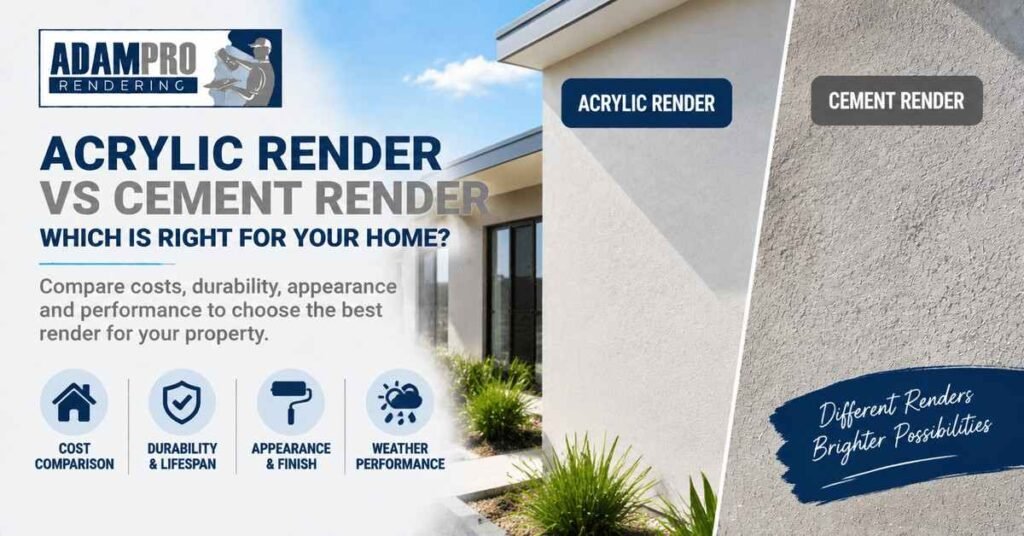
For exterior wall applications specifically, the choice between acrylic render vs cement render is not always one-or-the-other. The right decision depends on your substrate, your climate exposure, your budget, and how long you plan to hold the property.
Flexibility and durability differences
Acrylic render is the better choice for lightweight cladding systems, polystyrene cladding panels, Hebel blocks, and any substrate with known or expected movement. It is also the better choice for coastal properties, high UV exposure, and where the client wants minimal maintenance over ten or more years.
Cement render suits stable, traditional masonry substrates: solid brick, concrete block, and stone. It performs well on heritage homes where breathability is required and on projects where budget is the primary constraint. It can be painted with a flexible, UV-resistant exterior paint system to offset some of its performance limitations.
For exterior wall durability over a full property lifecycle, acrylic render’s flexibility reduces crack risk, and its water-repellent properties reduce water ingress risk. Both factors have a direct impact on long-term maintenance costs. Builders working on fixed-price contracts in Sydney’s Hills District and Northern Suburbs increasingly specify acrylic render on new project home façades to reduce call-back risk in the first decade.
A builder who works across both Sydney’s Northern Beaches and Western Suburbs noted that project timelines on homes using acrylic render are shorter than equivalent cement render jobs because there is no extended curing wait between coats. That time saving on a 15-home development is worth a material amount in reduced preliminaries costs.
Application and curing time
Cement render requires 24 hours minimum between coats under normal conditions, and full cure to painting strength takes 28 days. In wet weather, both timelines extend. Acrylic render reaches re-coat condition in two to four hours and can be painted within 24 to 48 hours of final application in Sydney’s climate.
For a homeowner who wants a project completed in a week rather than a month, acrylic render makes the schedule achievable. For a builder managing subcontractor sequencing, shorter curing time reduces the risk of weather delays affecting the critical path.
A property investor renovating a duplex in Parramatta chose acrylic render over cement render specifically to meet a lease-start date. The project completed on schedule, the render went on in two days, and the painter followed within 48 hours. Using cement render on the same project would have required a minimum two-week gap between the final render coat and painting.
Frequently Asked Questions
What are the advantages of Acrylic Render?
Acrylic render offers flexibility that resists cracking on substrates prone to movement, stronger adhesion across a wider range of surfaces, shorter curing time between coats, and better UV and water resistance than cement render. Pre-mixed formulations also provide consistent coat thickness and colour. These properties make it particularly suited to coastal or high-UV environments and lightweight cladding systems.
How does Cement Render differ from Acrylic Render?
Cement render is a mineral-based mix of Portland cement, sand, and lime applied in multiple coats with long curing periods. It offers breathability and lower material cost but limited flexibility, making it prone to cracking on moving substrates. Acrylic render incorporates polymer resins that add flexibility and water resistance, at a higher material cost and with faster curing times.
Is Acrylic Render worth the extra cost?
Acrylic render is worth the higher upfront cost on substrates with movement risk, coastal properties with high UV and rain exposure, and projects requiring fast turnaround. Over a ten to fifteen year period, lower maintenance costs from reduced cracking and water ingress can offset the initial price difference. For stable masonry on a tight budget, cement render remains a practical and durable choice.
What maintenance is required for Cement Render?
Cement render needs repainting every seven to ten years with a quality exterior paint to maintain weather resistance. Cracks wider than one millimetre should be raked out, filled with a flexible filler, and repainted rather than painted over. Salt-affected or coastal render may need more frequent inspection. Allowing hairline cracks to widen before treatment leads to more costly repairs.
Is acrylic render waterproof?
Acrylic render is water-resistant rather than fully waterproof. Its polymer content reduces water absorption substantially compared to cement render, and it resists water penetration under typical rain conditions. For complete waterproofing, such as in pool surrounds or below-ground applications, acrylic render is used alongside a dedicated waterproof membrane system rather than as a standalone waterproof barrier.
How much does acrylic render cost per square metre in Australia 2026?
Acrylic render costs between $50 and $80 per m² installed in Sydney for mid-2026 residential projects, covering materials, primer where required, and labour. Material cost alone ranges from $20 to $35 per m². Project size, access conditions, substrate preparation requirements, and finish specification all affect the final rate. Cement render by comparison costs $35 to $58 per m² installed.
What is the environmental impact of acrylic vs cement render?
Acrylic render contains petroleum-derived polymer resins that off-gas VOCs during application, though low-VOC formulations are available and add minimal cost. Cement render carries a higher embodied carbon footprint from Portland cement production but contains no petrochemical resins. Neither option is impact-free. Specifying low-VOC acrylic products and sourcing from Australian manufacturers reduces the combined environmental cost of either system.
Choose the Right Render for Your Property
The choice between acrylic render and cement render comes down to three variables: substrate type, climate exposure, and budget over time rather than just upfront cost. Acrylic wins on flexibility, weather resistance, and curing speed. Cement wins on breathability, heritage compatibility, and lower material cost.
For NSW and ACT homeowners, the conditions in most coastal and high-UV suburban areas favour acrylic render for exterior applications. Stable masonry in sheltered locations can perform well with cement render applied by a skilled tradesperson with proper surface preparation and an adequate curing period.
To get a recommendation specific to your property, substrate, and finish goals, contact Adam Pro on 0444 522 239 or email adam@adampro.com.au for a free site inspection and quote. Adam Pro provides professional cement and acrylic rendering across Sydney, the Central Coast, Newcastle, Wollongong, the Southern Highlands, and Canberra.