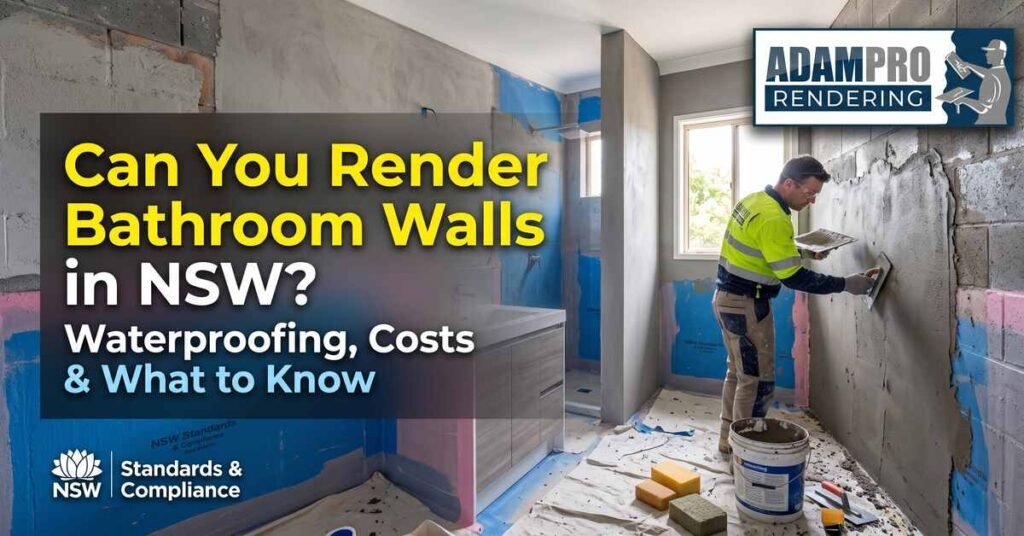
Yes, you can render bathroom walls, but render is not waterproof on its own. In NSW, wet areas need a compliant waterproofing membrane applied before any render or finish goes on, in line with AS 3740. Acrylic or polymer-modified render, microcement and polished plaster are the most common finishes for rendered bathroom walls.
Rendered bathroom walls are popular with Sydney, Central Coast, Newcastle and Wollongong homeowners who want a seamless, modern look without rows of grout lines. This guide explains how it works, what it costs, and how it compares with tiles.
What Are Rendered Bathroom Walls?
Rendered bathroom walls are walls finished with a cement-based or acrylic coating instead of tiles or painted plasterboard. The result is a smooth or lightly textured surface with no grout lines, which gives bathrooms a clean, continuous look.
Render can be applied over brick, besser block, Hebel (AAC) panels, and suitable fibre cement sheet, as long as the substrate is sound, clean and properly prepared.
Is Render Waterproof?
No. Standard cement render is porous and absorbs moisture. It is not a waterproofing system.
In a bathroom, the waterproofing must come from a certified membrane installed beneath the finish. Render then acts as the decorative and protective top layer. Skipping the membrane is the most common cause of mould, peeling, staining and damp problems in rendered bathrooms.
Wet area waterproofing in Australia is governed by AS 3740 and the National Construction Code. In NSW, waterproofing work in wet areas must be carried out by a suitably licensed contractor, so confirm current requirements with NSW Fair Trading before you start.
Can You Render a Shower Wall?
Yes, but a shower is the most demanding area in the bathroom. A rendered shower wall needs:
- A full waterproofing membrane across the shower walls, floor and corners
- Correct falls to the drain
- A render or finish designed for constant wet exposure, such as microcement or polished plaster with a compatible sealer
- Careful curing time before first use
Standard cement render alone is not suitable inside a shower recess without these layers.
Types of Render for Bathroom Walls
Cement render. Strong and affordable, but porous. It needs waterproofing beneath and a quality sealer or paint system over the top.
Acrylic or polymer-modified render. More flexible and water-resistant than traditional cement render. A common choice for splash zones and outer bathroom walls.
Microcement. A thin, seamless coating popular for showers and floors. It is usually installed over a waterproofed substrate and finished with a sealer.
Polished plaster. A lime-based finish with a smooth, marble-like look. It is suited to feature walls and, when sealed correctly, wet areas.
Textured render. Works well for outside-bathroom walls, courtyards and coastal-style designs.
Rendered Bathroom Walls vs Tiles
| Factor | Rendered walls | Tiles |
|---|---|---|
| Look | Seamless, modern | Classic, many patterns |
| Grout lines | None | Yes, need regular cleaning |
| Moisture resistance | Depends on membrane and sealer | High, with intact grout |
| Maintenance | Periodic resealing | Regrouting over time |
| Repairs | Needs skilled patching | Individual tiles can be replaced |
| Cost | Varies widely by finish | Varies by tile and labour |
Tiles are still the safest choice for inside the shower. Many NSW homeowners use a hybrid approach: tiles in the shower recess and render on the remaining walls.
Which Surfaces Can Be Rendered?
- Brick: an excellent base when clean and sound.
- Besser block: commonly rendered; may need a bonding agent.
- Hebel (AAC): can be rendered with the right primer and system; follow the manufacturer’s guidelines.
- Fibre cement sheet: suitable with a compatible base coat and mesh reinforcement.
Always check the substrate for movement, damp and cracks before rendering. If you are building new walls, AdamPro also offers Hebel installation in Sydney and NSW.
How Much Do Rendered Bathroom Walls Cost in NSW?
Costs depend on the finish, wall condition, access, and the amount of waterproofing needed. As a rough guide:
- Cement or acrylic render: typically in the range of $40 to $100 per square metre
- Microcement or polished plaster: typically $150 to $350 per square metre
- Waterproofing: priced separately by a licensed waterproofer
These are indicative figures only. Prices in Sydney are usually higher than in regional NSW. Get at least three written quotes before committing. For whole-house pricing, see AdamPro’s guides on how much cement rendering costs and how much house rendering costs in Australia.
How Are Bathroom Walls Rendered? Step by Step
- Prepare the surface. Clean, repair cracks and make sure the wall is dry and structurally sound.
- Waterproof. A licensed contractor applies the membrane to AS 3740 requirements and allows it to cure.
- Apply a bonding coat or primer if needed for the substrate.
- Apply the base coat, often with mesh reinforcement at joints and corners.
- Apply the finish coat and trowel to the desired texture.
- Cure the render according to the product guidelines, which can take days.
- Seal or paint with a product rated for wet areas.
Common Problems With Render Bathroom Walls
Mould and mildew. Usually caused by poor ventilation or missing waterproofing. Fit an exhaust fan and keep the room well ventilated.
Cracks. Often from substrate movement, rushed curing or no mesh at joints. Small cracks can be filled and resealed; larger ones need professional repair.
Efflorescence. White salt deposits from moisture moving through cement-based render. Fix the moisture source first, then clean and reseal.
Peeling paint or sealer. Usually the wrong product for a wet area or poor surface preparation.
How to Maintain Rendered Bathroom Walls
- Clean with a mild, non-abrasive cleaner and a soft cloth
- Avoid harsh acids and strong bleach, which can damage sealers
- Reseal every few years, or as the manufacturer advises
- Run the exhaust fan during and after showers
- Fix small cracks early before water gets in
Frequently Asked Questions
Can you put render in a shower?
Yes, but only over a compliant waterproofing membrane and with a finish designed for wet areas, such as microcement or polished plaster with a suitable sealer. Standard cement render alone is not suitable for a shower recess.
Does render absorb water?
Yes. Traditional cement render is porous and absorbs moisture unless it is sealed or built over a waterproof membrane. Acrylic and polymer-modified renders absorb less.
How do you waterproof rendered bathroom walls?
Waterproofing goes underneath the render, not on top of it. A licensed waterproofer applies a membrane to the substrate to AS 3740 requirements. The render is then applied over the cured membrane and sealed.
Are rendered bathroom walls better than tiles?
Not in every area. Render walls give a seamless look and avoid grout lines, but tiles generally perform better inside the shower. Many homes use tiles in wet zones and render elsewhere.
How long do rendered bathroom walls last?
With correct waterproofing, quality materials and regular resealing, render bathroom walls can last many years. Lifespan depends on the finish, ventilation and maintenance.
Do I need a licensed waterproofer in NSW?
Waterproofing in wet areas is licensed work in NSW. Check the current licensing rules and thresholds with NSW Fair Trading, and always ask to see a contractor’s licence number before work starts.
Final Thoughts
Rendered bathroom walls can look stunning, but the result depends on what is behind the finish. Get the waterproofing right, choose a render system suited to wet areas, and use a skilled applicator.
Planning a render project in Sydney, Newcastle, the Central Coast, Wollongong, the South Coast or Canberra? AdamPro provides cement rendering, acrylic rendering, polymer rendering and texture coat rendering across NSW and Canberra. Call 0444 522 239 or request a free quote.